Showing posts with label bio-fuels. Show all posts

Sunday, June 6, 2010

The End of Oil

It was about 10 years ago that I first started to think about energy resources and the potential oil crisis. We had this UNESCO project for associated schools and I volunteered to organize some activities..."..the looming energy crisis", "...an oil-dependent system"... etc. - I clearly remember the information materials, which were warning about prospective disasters and explaining sustainable alternatives.

This week I had the chance to attend a documentary movie projection and discussion about "peak-oil" at TU-Berlin, part of the Heinrich-Böll Foundation Campus Tour 2010. The discussions after the documentary made me think about a few issues that I had not considered before. I have naturally felt comfortable in the green political environment, because I would recognize concern for issues which are also of great importance to me. At times however I have realized that my philosophy is somehow different - I would care about the same issues, just as convinced as other environment-minded people, yet my understanding of underlying reasons and the need to focus on specific problems would be in some way dissimilar. I think the oil crisis discussion is a very good example of my disconcertion.

"Green-minded" people in Germany believe in the importance of their individual actions. In the case of oil, an applied approach is what many are looking for - how to make themselves independent of oil. The documentary showed a community in Saxony-Anhalt, which was trying to make itself oil-neutral, e. g. using horses instead to a tractor, building with clay and other environmentally friendly materials, etc. Many questions and the discussion afterwards had one flavor: how do we make ourselves independent of oil? how to demonstrate our concern with our consumer behavior?

Source: www.toonpool.com

When some activists talk about the oil crisis problem, they picture it as a resource disappearing almost over night... as if we would wake up one morning and there would be no more fuel for the cars and the airplanes, no more synthetic materials for live-saving drugs, etc. The applications of oil are many indeed and our industrial system is heavily dependent on it. The big question is how much of it is left and for how long the reserves would be able to maintain the current consumption levels. Many experts ascertain that we are starting to slide on the right side of the hump-shaped curve, which represents the resource stock.

I don't worry so much that some day our industrial system would come to a standstill because of oil. For one we know that the market system would signal the decreasing stock and many technological alternatives will become economically viable. I think the argument is misplaced. There are several issues which were not slightly mentioned in the green political discussion:

- A potential energy crisis will have enormous distributional effects on a global level. All commodities will become more expensive and industrialized nations' middle class will no longer be able to enjoy the opulent lifestyle it is used to. I find this the least dire consequence - these people are already living beyond their means (resource exploitation on a inter- and intragenerational level) and they would recognize that he fossil fuel bonanza was bound to end. Precisely because of this I would criticize the self-seeking and self-centered behavior of "green-minded" people who want to "learn how to plant own potatoes.." (citing film maker Matthias Sdun).  Such self-centered behavior does not consider the issue in its true trans-regional nature, but looks for an easy way out for a few well-to-do, bored relatively rich people, simply disgraceful. The energy crisis is a question of global equity and fairness for generations to come.

- It could well be that poorer countries would suffer the most, since they will be dependent on innovative technologies, developed by advanced industrialized nations. We know however that developed nations have more oil-intensive production industries, reflected in the much higher CO2-emissions per capita, which speaks for the fact that developing countries are less oil-dependent. The standard discussion considers the possibility of less-developed countries leap-frogging forward through the implementation of clean renewable technologies and avoiding the oil-powered heavy industrialization, which today's developed countries had to go through. This however is dependent on how much support these countries will get from the affluent industrialized states and this support is precisely what the "green-minded" people should be lobbying for. Additionally they should carefully consider what bio-fuel preudo-solutions hold at stake.
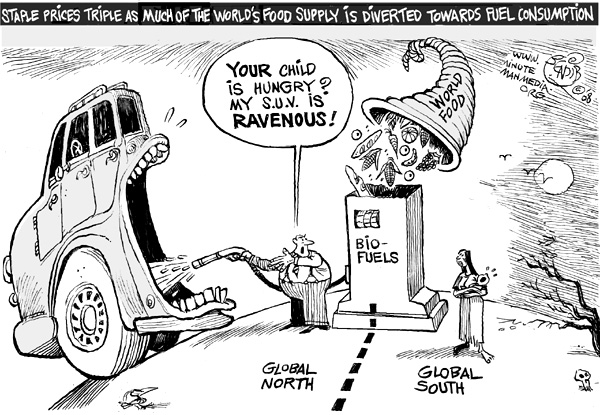
Source: www.bendib.com

- The oil crisis question is inextricably linked to the climate change crisis as well as to environmental disasters resulting from oil exploitation. In both cases there is an enormous negative spill-over, which can be only hardly measured and monetarized. The least BP could do is to resign from paying dividends to shareholders this year. How could it be that this company would still make profits and distribute them to equity-holders after it caused one of the greatest environmental disasters in history? Preposterous.

Tuesday, December 15, 2009

Palm Oil, A Non-sustainable Solution

The need to reform the energy system has brought up a controversy about the climate and sustainability footprint of bio-energy. The pledge of the European Commission to have 10% biofuels in transport by 2020 (current proportion amounts to 5%) will require significant increase in the imports of palm oil. We sat down with Philipp Dera and discussed his recently published book "Biodiesel" - a growth market with guaranteed sustainability?, which deals with the socio-economic dimensions of palm oil production in Indonesia. The author investigates the question if ecological standards can offer a solution to the various goal conflicts that arise from the production of palm oil for the Indonesian export industry.


The European Union will not be able to cover the 5% increase in biomass fuel proportion from the European canola fields, instead, it will resort to importing cheap biomass from the developing world. Indonesia as one of the biggest palm oil producing and exporting countries is facing difficulties on all levels of sustainability:

From an environmental point of view, since new arable land will be needed for agricultural plantations, more tropical forests will have to be cleared and the soil oxidization will lead to massive emissions of stored carbon (a process also known as tropical peatland degradation). Although Indonesia does not have heavy industries compared to other developed countries, it is still the third biggest greenhouse gas emitter (closely followed by Brazil), solely based on cutting and burning rainforest.

There is also a significant social impact, connected with distributional equity. The price of palm oil has risen 50% in the internal Indonesian market already and the growing demand from abroad will lead to further escalations in the prices. Lower income families will be disproportionately affected by the rising price, because they are dependent on palm oil as a main source of nutrition. Even the attempt on the EU side to proclaim "grey areas" or grassland as sustainable arable land, does not take into consideration that indigenous people and small subsistence farmers heavily depend on this land for farming.

Indonesia is concentrating on the production of palm oil as a main export industry and thus creates a dangerous economic dependency. While crops like canola and maize are harvested annually, growing palm oil is a slow process. it takes a minimum of four years until the palm beans can be gathered in. Volatile prices would thus affect palm oil producers much more severely than canola and maize producers.

If we look at the demand on the European market, one finds that palm oil today is an ingredient omnipresent regardless of the field of consumption. You can find it in cosmetics, alimentation, heating and fuels so the average person has no means of changing what one consumes. The adjustments needed are beyond one's reach. We think we have the freedom of choice as consumers, but when we buy a product there is no guarantee that it will not contain palm oil, because there is a lack of proper labeling/insufficient regulations about labeling. One example is vegetable oil, which is not always labeled as palm oil. Another example is bio-diesel, which is a mix of fossil fuels and bio-fuel that one has no influence on.

It is the European Union that we expect to make the required sustainable solutions, but there is a goal conflict on the institutional level as well: energy and climate policy. The EU has created the bio-energy industry through its substantial subsidies to European farmers. Instead of leaving uncultivated land, farmers could plant canola and a whole industry was created from this politically induced process. Now this industry and the energy lobby are persuading the European administration with the argument that refineries and other biofuel production structures already exist and they are not fully utilized, so additional biomass can be imported without increasing the production capacities. For the EU, bio-diesel solves several problems with one strike:

- greenhouse gas emissions will be reduced (the emissions from deforestation and degradation in Indonesia are not on the EU's bill),
- resource diversification will make Europe less dependent on oil, which either way the planet is running out of,
- it makes sense from geopolitical point of view, since it will weaken the dependency on oil from the Middle East.

The climate lobby, familiar with the heated debates on bio-ethanol, requires now the introduction of a certification system that would separate sustainable palm oil producers. The problem however is that sustainable certification never existed in the bio-fuel business. There is no system for monitoring and control and no way to guarantee that the Asian bio-fuel companies will not cheat. These companies are in fact making use of the weak regulation system in Indonesia, where e.g. conflicts about traditional property and land rights often are solved through unofficial channels.  Institutional deficiencies enable corruption and empower the big palm oil corporations, putting small producers at a disadvantage. As the biggest importer of palm oil, the EU is effectively giving the wrong incentives and setting incompatible goals.

We finished our discussion considering the solutions from the consumer and the institutional perspective. The only reasonable answer, which is the conclusion of the book, is a complete EU ban on palm oil production until a workable certification system is developed, which would match the goals of sustainability.

Philipp was a student of political science, economics and South Asian studies at the Humboldt University in Berlin. He speaks Indonesian and his frequent visits in the region have enabled him to gain an acute understanding of the most import issues at stake. He cooperates with NGOs like "Watch Indonesia!", which try to raise awareness on democracy, human rights and environmental issues.

Maria Elena and Velichka