It was about 10 years ago that I first started to think about energy resources and the potential oil crisis. We had this UNESCO project for associated schools and I volunteered to organize some activities..."..the looming energy crisis", "...an oil-dependent system"... etc. - I clearly remember the information materials, which were warning about prospective disasters and explaining sustainable alternatives.
This week I had the chance to attend a documentary movie projection and discussion about "peak-oil" at TU-Berlin, part of the Heinrich-Böll Foundation Campus Tour 2010. The discussions after the documentary made me think about a few issues that I had not considered before. I have naturally felt comfortable in the green political environment, because I would recognize concern for issues which are also of great importance to me. At times however I have realized that my philosophy is somehow different - I would care about the same issues, just as convinced as other environment-minded people, yet my understanding of underlying reasons and the need to focus on specific problems would be in some way dissimilar. I think the oil crisis discussion is a very good example of my disconcertion.
"Green-minded" people in Germany believe in the importance of their individual actions. In the case of oil, an applied approach is what many are looking for - how to make themselves independent of oil. The documentary showed a community in Saxony-Anhalt, which was trying to make itself oil-neutral, e. g. using horses instead to a tractor, building with clay and other environmentally friendly materials, etc. Many questions and the discussion afterwards had one flavor: how do we make ourselves independent of oil? how to demonstrate our concern with our consumer behavior?

Source: www.toonpool.com
When some activists talk about the oil crisis problem, they picture it as a resource disappearing almost over night... as if we would wake up one morning and there would be no more fuel for the cars and the airplanes, no more synthetic materials for live-saving drugs, etc. The applications of oil are many indeed and our industrial system is heavily dependent on it. The big question is how much of it is left and for how long the reserves would be able to maintain the current consumption levels. Many experts ascertain that we are starting to slide on the right side of the hump-shaped curve, which represents the resource stock.
I don't worry so much that some day our industrial system would come to a standstill because of oil. For one we know that the market system would signal the decreasing stock and many technological alternatives will become economically viable. I think the argument is misplaced. There are several issues which were not slightly mentioned in the green political discussion:
- A potential energy crisis will have enormous distributional effects on a global level. All commodities will become more expensive and industrialized nations' middle class will no longer be able to enjoy the opulent lifestyle it is used to. I find this the least dire consequence - these people are already living beyond their means (resource exploitation on a inter- and intragenerational level) and they would recognize that he fossil fuel bonanza was bound to end. Precisely because of this I would criticize the self-seeking and self-centered behavior of "green-minded" people who want to "learn how to plant own potatoes.." (citing film maker Matthias Sdun). Such self-centered behavior does not consider the issue in its true trans-regional nature, but looks for an easy way out for a few well-to-do, bored relatively rich people, simply disgraceful. The energy crisis is a question of global equity and fairness for generations to come.
- It could well be that poorer countries would suffer the most, since they will be dependent on innovative technologies, developed by advanced industrialized nations. We know however that developed nations have more oil-intensive production industries, reflected in the much higher CO2-emissions per capita, which speaks for the fact that developing countries are less oil-dependent. The standard discussion considers the possibility of less-developed countries leap-frogging forward through the implementation of clean renewable technologies and avoiding the oil-powered heavy industrialization, which today's developed countries had to go through. This however is dependent on how much support these countries will get from the affluent industrialized states and this support is precisely what the "green-minded" people should be lobbying for. Additionally they should carefully consider what bio-fuel preudo-solutions hold at stake.
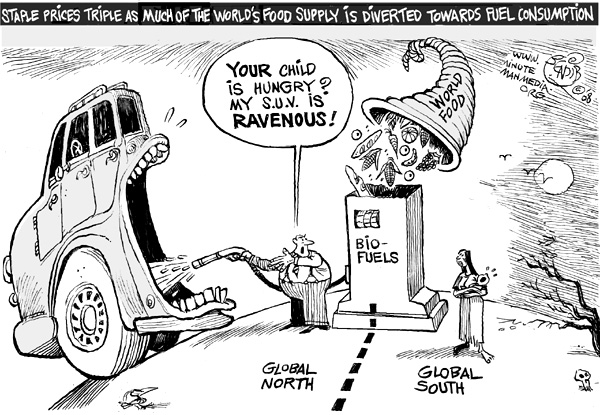
Source: www.bendib.com
- The oil crisis question is inextricably linked to the climate change crisis as well as to environmental disasters resulting from oil exploitation. In both cases there is an enormous negative spill-over, which can be only hardly measured and monetarized. The least BP could do is to resign from paying dividends to shareholders this year. How could it be that this company would still make profits and distribute them to equity-holders after it caused one of the greatest environmental disasters in history? Preposterous.


 Posts
Posts

